An island connection carried by people
Key West sits close enough to the Bahamas for the two island communities to have long shared routes of travel, work, and family connection. Bahamian migrants were among the people who helped shape Key West’s neighborhoods and everyday life. Their influence is visible not only in the food served to visitors, but also in home cooking and the traditions families have carried forward.
That history matters when a dish is described simply as “Key West food.” The island’s cooking draws on several communities, and Bahamian contributions deserve to be named rather than folded into a vague tropical identity. Bahama Village, a Key West neighborhood associated with Bahamian heritage, is one reminder that food traditions belong to people and places, not just menus.
Why conch became a shared food symbol
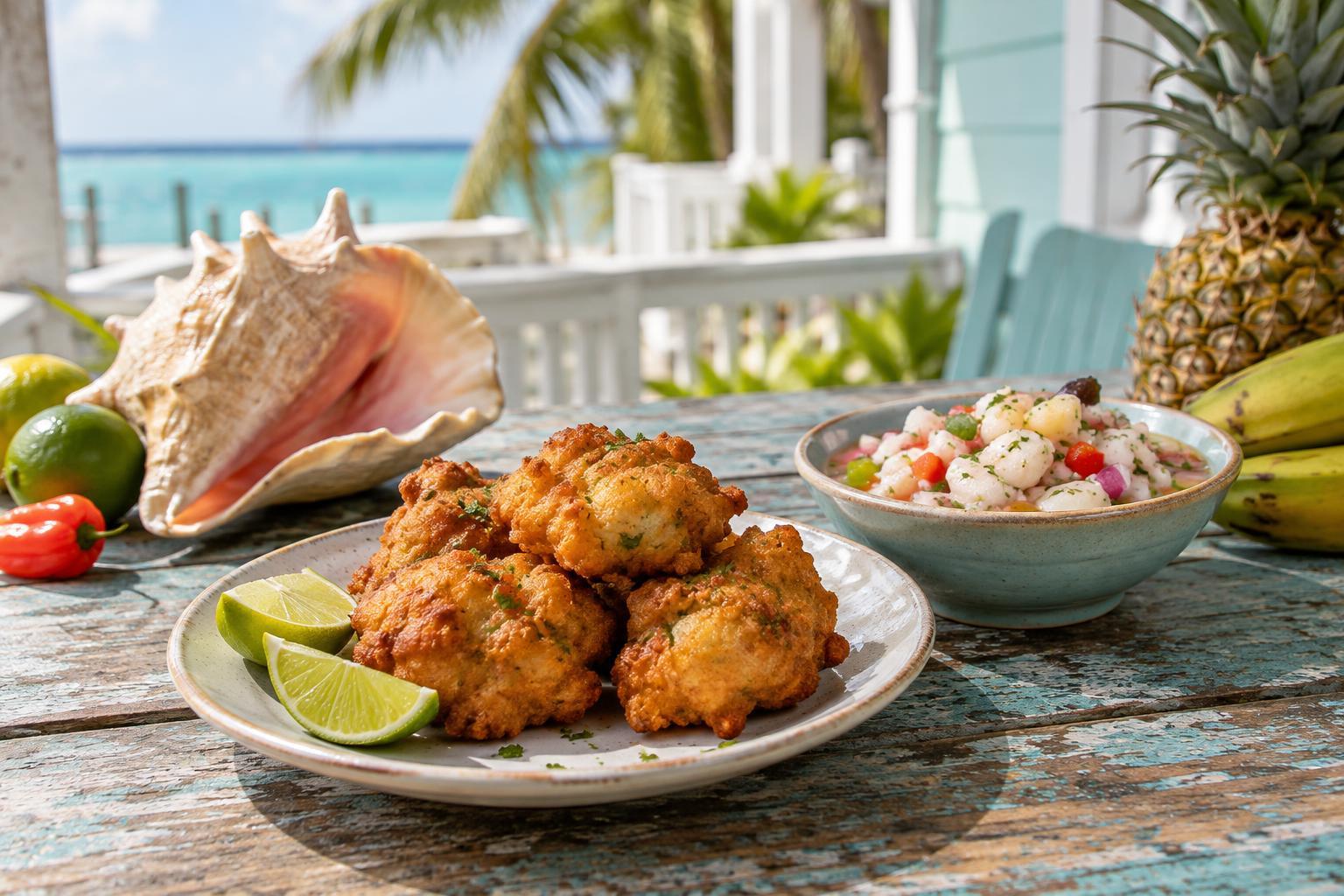
Conch, a large marine snail, is closely associated with Bahamian cooking and has also become a familiar symbol of Key West. Its meat is firm and needs thoughtful preparation: it may be tenderized, chopped finely, or cooked slowly, depending on the dish. Cooks in both places have used those approaches to make conch satisfying rather than tough.
Conch fritters show how an ingredient can travel and change. Small pieces of conch are mixed into seasoned batter and fried until the outside is crisp. One cook might emphasize sweet pepper and onion; another might use a different pepper or serve a sharper dipping sauce. Conch salad offers another contrast: commonly associated with the Bahamas, it brings chopped conch together with citrus, vegetables, and pepper for a bright, fresh preparation. Key West menus may offer versions of both dishes, but a shared name does not guarantee an identical recipe.
Conch’s place in local culture does not mean it can be harvested freely from nearby waters. Harvest rules and supply differ by location, and a conch dish served in Key West is not necessarily made with locally caught conch. If provenance matters to you, ask where the conch came from rather than assuming.
Adaptation is part of the tradition
Migration rarely leaves a recipe unchanged. A family might keep a preferred seasoning while adjusting to ingredients available in Key West. A restaurant might make a fritter that holds up well for service, while a home cook prepares conch in a slower, more personal way. Differences in heat, acidity, texture, and accompaniments can reflect both preference and circumstance.
It is tempting to look for one definitive Bahamian or Key West version of a dish, but doing so can flatten a living food culture. A pepper-forward conch salad, a bowl of conch chowder, and a plate of fritters can each prompt a different conversation about where a cook learned the recipe and whom they make it for. The most useful question may be “What is your version?” rather than “Is this authentic?”
Conch is only one part of this story. Seafood, rice dishes, beans, citrus, peppers, and other ingredients appear in the broader cooking of these islands. No single plate can represent every Bahamian family or every Key West kitchen. Paying attention to the cook and the context makes the connections more meaningful than treating conch as a novelty.
How to explore the connection thoughtfully
When eating in Key West, read a menu for details beyond the word “conch.” Is it a salad, fritter, or soup? Does the description tell you how it is seasoned or prepared? If the setting invites conversation, ask about the dish’s inspiration without expecting a server or cook to speak for an entire community. A good meal can be a starting point for curiosity, not a claim to have mastered the history.
At home, borrow a principle rather than pretending one recipe captures a whole tradition. For fritters, finely chopped seafood or vegetables can be folded into a seasoned batter and fried in small portions; for a salad, balance crisp vegetables, citrus, and pepper to your taste. If using conch, buy it from a reputable seller and check its origin and applicable rules. That attention to sourcing is as much a part of thoughtful cooking as the seasoning.
The Bahamian influence on Key West food culture is best understood as an ongoing relationship among people, ingredients, and place. Conch makes that relationship easy to spot, but the deeper story lies in migration, adaptation, and the care with which traditions are shared.