Start by deciding what local means to you
At a Florida market, “local” might mean grown in the same county, elsewhere in the state, or within a vendor’s wider sourcing area. The word alone does not tell you which. Before shopping, decide what matters most to you: supporting a nearby farm, buying Florida-grown food, finding recently harvested produce, or simply understanding its route to the stall. Those goals overlap, but they are not identical.
Look for a market’s vendor descriptions or posted rules if they are available. Some markets distinguish growers from sellers who source produce from other farms or distributors. A grower may also bring in items from a neighboring farm to offer more variety. None of these arrangements automatically tells you whether the produce is good; they tell you which questions will help you make an informed choice.
Ask where it was grown, not just where the seller is based
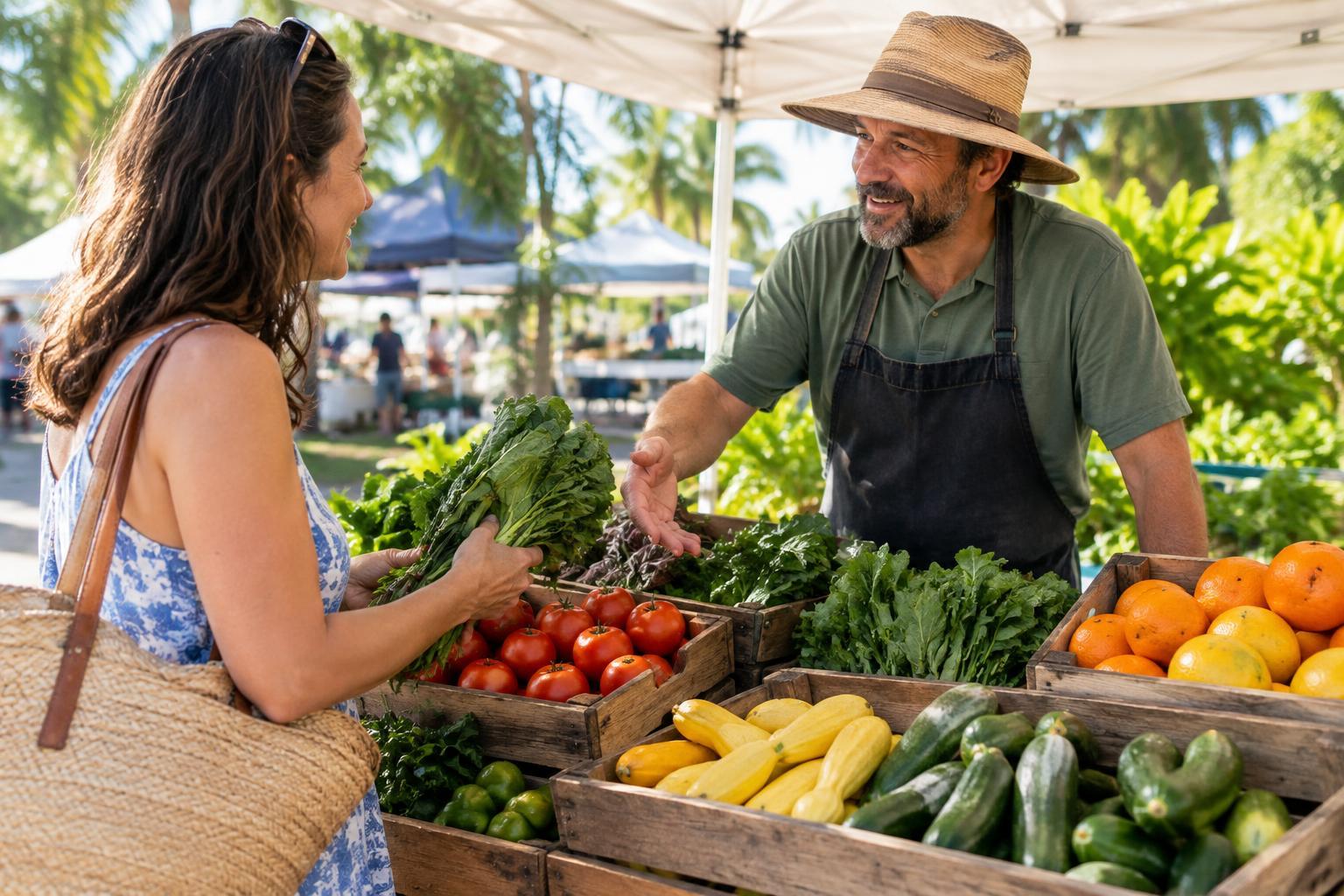
The most useful opening question is simple: “Where was this grown?” If the answer is broad, such as “Florida,” and you want to know more, ask what county or area the farm is in. A stall can be locally owned while carrying produce grown farther away. Likewise, a vendor may have traveled from another part of Florida to sell a crop grown on their own farm.
For a mixed display, point to the specific item you are considering. Origins can vary from one crate to the next, even for the same kind of fruit or vegetable. You might ask, “Did you grow these tomatoes, or did they come from another farm?” If another farm supplied them, “Do you know where that farm is?” gives the seller room to share what they know without asking them to prove more than they can.
Use follow-up questions to learn the produce’s route
Knowing the growing location is a good start, but it may not answer every question you have. If freshness is your priority, try “When were these picked?” or “Did they come straight from the farm to this market?” A seller may give an approximate answer, particularly when several people handled a crop. That is more useful than assuming every item at a farmers market was harvested the day before.
You can also ask whether the vendor grows everything on the table or supplements their harvest with produce from other farms. For a reseller, the relevant question is where a particular item was sourced. Listen for clear distinctions: “We grew the greens, but the citrus came from another Florida grower” tells you much more than a blanket “It’s all local.” If the seller does not know an item’s origin, you can choose something else without making the exchange adversarial.
Treat signs and seasonal clues as prompts, not proof
Signs are handy starting points, especially when a stall is busy. Read them closely: “grown in Florida,” “from our farm,” and “locally sourced” make different statements. A farm name on a banner may identify the business, but it may not describe every item on the table. Boxes and stickers can provide clues, too, although packaging may be reused. When the distinction matters to you, confirm it with the person selling the produce.
Seasonality can help you notice what deserves a question. Florida’s growing conditions differ across regions, and weather can shift harvest timing, so there is no single calendar that settles an item’s origin. An unexpected crop is not proof that a sign is wrong; it is an invitation to ask how and where it was grown. Protected growing methods, storage, or sourcing from another region may explain why an item appears when you did not expect it.
Keep the conversation useful and courteous
Market stalls can get crowded. Ask one or two specific questions, then leave room for the vendor to serve others. If you want a longer conversation about a farm’s practices, return during a quieter moment when possible. Questions such as “Which of these did you grow?” and “What came from other farms?” are direct without suggesting that buying from another grower is a problem.
Finally, let the answers guide your purchase rather than searching for a perfect label. You might buy nearby-grown greens from one stall and Florida-grown fruit from another, or choose a nonlocal ingredient because it suits your meal. Learning the difference helps you shop according to your priorities. The best outcome is not catching someone out; it is leaving the market knowing a little more about the food you are taking home.